WPI Inflation Rises to 9.68% in May 2026: Fuel, Food & Manufactured Items Drive Price Surge
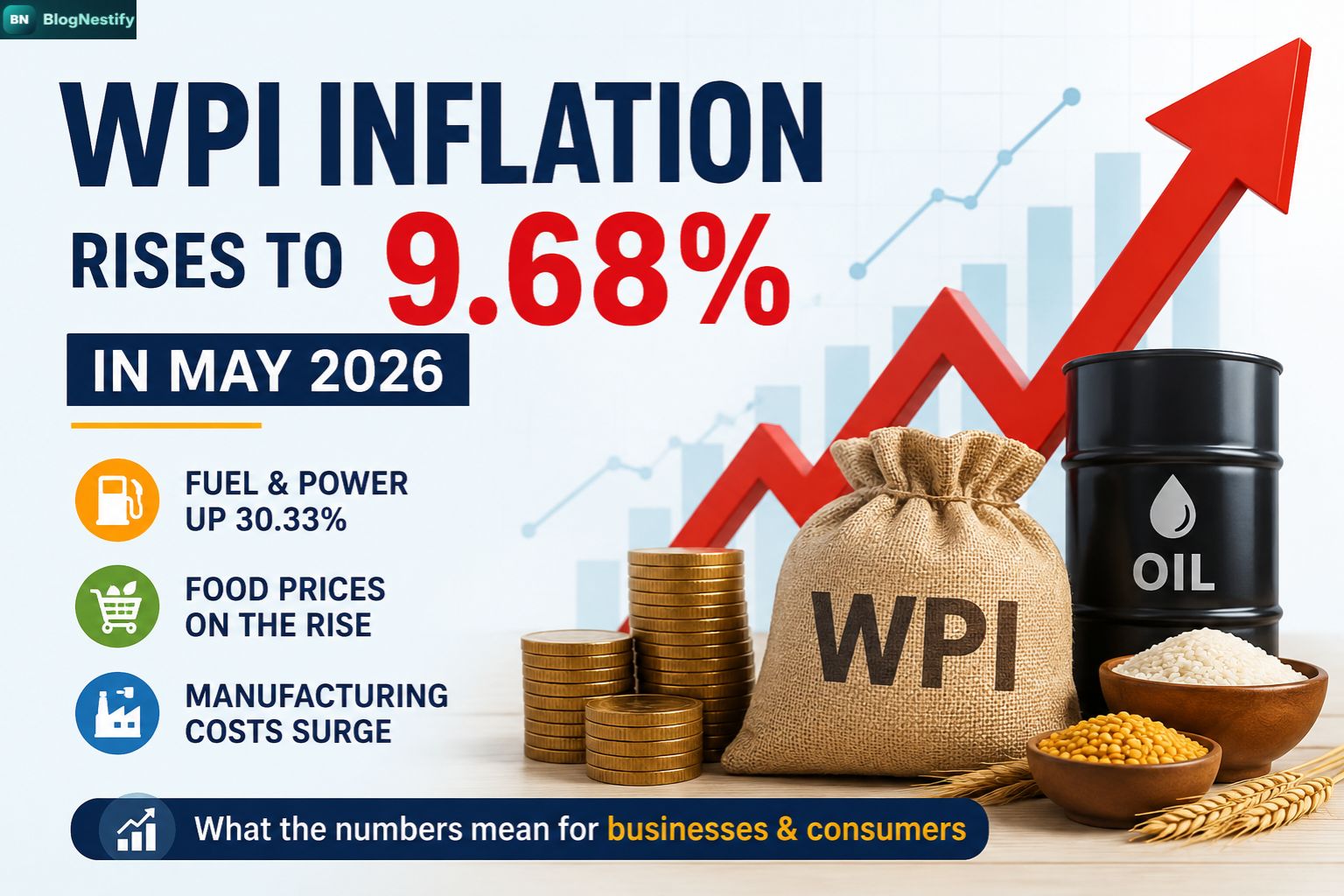
India's wholesale prices climbed sharply in May as fuel & power inflation hit 30.33%, crude petroleum crossed 61%, and manufacturing costs kept climbing — all against the backdrop of an ongoing West Asia crisis.
May 2026
Inflation
Inflation
Products
Index
Forecast FY27
Monday's data dump from the Ministry of Commerce and Industry was not a pleasant read. India's Wholesale Price Index-based inflation climbed to 9.68% in May 2026, up from 8.26% the month before — the steepest reading in recent months and a clear signal that input cost pressures are far from letting up.
The number tells a straightforward story: energy costs are in overdrive, food prices are creeping up, and manufacturers are absorbing cost shocks that will eventually show up in retail prices. The West Asia crisis, particularly the disruption around the Strait of Hormuz, sits at the centre of most of this.
WPI inflation surged to 9.68% in May 2026 from 8.26% in April, driven by a 30.33% jump in fuel & power costs, a 61.51% spike in crude petroleum prices, rising food inflation at 4.49%, and manufactured products inflation at 7.48%. The Commerce Ministry also released a revised WPI series with a new base year of 2022-23, replacing the old 2011-12 base.
What the May 2026 WPI Data Actually Shows
The overall WPI for all commodities reached 109.9 in May, up from 108.8 in April. That might seem like a small move in index points, but the year-on-year inflation number — 9.68% — shows just how far prices have travelled from where they were twelve months ago.
Every major segment of the WPI basket registered higher inflation compared to April. There was no bright spot in the data, which is unusual. Typically, if fuel is running hot, food might cool things off — or manufacturing inflation would stay contained. That's not what happened in May.
| WPI Category | May 2026 Inflation | April 2026 Inflation | Change |
|---|---|---|---|
| Overall WPI | 9.68% | 8.26% | ▲ 1.42 pp |
| Fuel & Power | 30.33% | 24.89% | ▲ 5.44 pp |
| Crude Petroleum & Natural Gas | 61.51% | 56.31% | ▲ 5.20 pp |
| Mineral Oils | 49.82% | — | — |
| Manufactured Products | 7.48% | 6.68% | ▲ 0.80 pp |
| WPI Food Index | 4.49% | 3.11% | ▲ 1.38 pp |
| Food Articles | 3.60% | 2.43% | ▲ 1.17 pp |
| Primary Articles | 4.99% | 3.78% | ▲ 1.21 pp |
Fuel & Power: The Dominant Force Behind May's Spike
The numbers in the fuel segment are striking. At 30.33%, fuel and power was the single biggest contributor to the overall WPI reading in May. And at 61.51%, crude petroleum inflation is running at levels that create serious second-round effects across the entire economy — from transportation to manufacturing to food logistics.
The West Asia crisis has been the main driver. The effective blockade of the Strait of Hormuz, through which a large share of India's crude imports pass, pushed global oil prices significantly higher. India imports roughly 85% of its crude oil requirements, leaving little domestic buffer against such external shocks.
The ongoing West Asia conflict disrupted the Strait of Hormuz — a chokepoint for oil shipping. Rising global crude benchmarks, combined with a weaker rupee, drove India's import costs sharply higher. This directly fed into the wholesale fuel price index. In the second half of May alone, petrol and diesel prices were raised by ₹7.50 per litre — the first significant fuel price hike since 2022.
It's worth noting that mineral oils — which include refined petroleum products — also registered inflation of 49.82%. That's the cost of fuel sitting in storage tanks, delivery trucks, and manufacturing plants. When those costs rise by nearly half in a year, it flows through every part of the supply chain.
Food Inflation at the Wholesale Level: Mild, But Moving
Food inflation in the WPI basket is not at crisis levels — not yet. The WPI Food Index rose to 4.49% in May from 3.11% in April, and food articles specifically registered 3.60% versus 2.43% in the prior month.
That acceleration is partly a direct consequence of higher fuel costs. Higher diesel prices mean higher transportation costs for agricultural produce. Higher input costs — fertilisers, irrigation power, packaging — also feed into the farm-gate price. The West Asia crisis has made this connection much tighter than usual.
The good news — if there is any — is that the food spike at the wholesale level has not yet reached alarming territory. Retail food inflation, captured in the CPI, rose to 4.2% in April and could trend slightly higher in June if wholesale pressures persist. That's worth watching, but it's not a crisis signal on its own.
📊 WPI vs CPI: Why Both Matter
The WPI measures price changes at the producer or wholesale stage, before goods reach consumers. The CPI captures what households actually pay at retail. WPI inflation at 9.68% is significantly higher than India's retail CPI inflation of 3.93% in May 2026. That gap exists partly because energy — which is highly weighted in WPI — is partially subsidised or price-regulated at the consumer end. But when WPI stays high for sustained periods, CPI usually follows.
Manufacturing Inflation Climbs to 7.48%
Manufacturing sector inflation in the WPI rose to 7.48% in May, up from 6.68% in April. This segment covers everything from basic metals and chemicals to food products and textiles — and the broad-based rise suggests that cost pressures are not concentrated in any single industry.
Higher energy costs are the primary culprit. Factories use electricity, natural gas, and fuel for production, logistics, and heating. When fuel prices jump by 30%, manufacturing input costs inevitably follow — even if with some lag. The question is how much of this cost manufacturers absorb themselves versus passing on to buyers. In a competitive market, the answer is: some combination of both, and neither option is comfortable.
For India's export-oriented manufacturers, this creates a double squeeze. Raw material costs go up. Shipping and logistics costs go up. Meanwhile, global buyers may resist higher prices, especially if competitors in other countries are not facing the same energy shock. This could weigh on export margins in the months ahead.
New WPI Base Year: 2022-23 Replaces 2011-12
Alongside the monthly data, the Ministry of Commerce and Industry released the May figures on a revised WPI series with a new base year of 2022-23, replacing the old 2011-12 base that had been in use for over a decade.
This is a significant methodological update. The revised series updates the basket of goods, adjusts weights to reflect current consumption and production patterns, and relocates crude petroleum and natural gas from the "primary articles" group to the "fuel and power" group — a more logical classification given how tightly crude prices track energy markets.
| Series Feature | Old Series (2011-12) | New Series (2022-23) |
|---|---|---|
| Base Year | 2011-12 | 2022-23 |
| Crude Petroleum Classification | Primary Articles | Fuel & Power Group |
| Linking Factor (All Commodities) | — | 1.53 |
| Linking Factor (Primary Articles) | — | 1.71 |
| Linking Factor (Fuel & Power) | — | 1.65 |
| Linking Factor (Manufactured Products) | — | 1.44 |
The Ministry has cautioned that direct historical comparisons between the old and new series should be made carefully, because the item baskets changed significantly. New goods were added; obsolete ones were dropped. Linking factors have been fixed to allow continuity in analysis, but the numbers are not directly comparable to WPI readings published before this revision.
RBI's Response: Inflation Projection Raised to 5.1%
The Reserve Bank of India, in its most recent monetary policy review this month, raised its inflation projection for FY2026-27 to 5.1%, up from the earlier estimate of 4.6%. The central bank kept the repo rate unchanged at 5.25% and maintained a neutral stance, but flagged crude oil price volatility and the Iran conflict as upside risks.
The RBI's concern is less about the current WPI number and more about the secondary effects. The direct impact of the ₹7.50 per litre fuel price hike in late May is estimated at around 8 basis points on CPI inflation for both May and June 2026, with mild indirect effects adding roughly another 10 basis points. Small numbers individually — but they compound over time, and the direction is clearly upward.
With inflation rising and global energy markets volatile, the RBI is in a difficult position. Cutting rates risks stoking inflation further. Raising rates could cool growth at a time when the economy is absorbing the external oil shock. The central bank's "neutral" stance reflects this dilemma — and until crude prices stabilise, don't expect a quick shift in either direction.
West Asia Crisis: The Macro Driver India Cannot Control
Nearly every major inflationary pressure in the May WPI data leads back to the same root cause: the West Asia crisis and its impact on global crude oil markets. The Strait of Hormuz remains a critical transit route for India's energy imports, and any disruption there translates almost immediately into higher import costs.
There was a temporary ceasefire agreement between the US and Iran, which offered brief relief. But markets remain cautious. As long as geopolitical uncertainty persists in the region, India's energy import bill stays elevated — and so does wholesale inflation across fuel-sensitive sectors.
Indian oil marketing companies (OMCs) passed on part of the higher crude cost through the ₹7.50 per litre retail fuel price hike in May. LPG prices were also raised by domestic suppliers in March, with effects that likely carried into April and May. These are pass-through costs — they show up in WPI first, then migrate to CPI over the following weeks and months.
What This Means for Businesses and Consumers
For Businesses
Any business with significant energy or logistics costs is under pressure. Manufacturers, distributors, cold-chain operators, and exporters will feel the pinch most acutely. Companies that locked in fuel or raw material contracts earlier in the year are better placed than those buying spot. The next quarter's earnings will tell a clear story about margin compression.
For Consumers
Retail prices typically lag wholesale by a few weeks to months. The ₹7.50 per litre fuel hike has already reached pump prices. Expect gradual increases in transportation costs for goods — which means slightly higher prices for vegetables, dairy, processed food, and manufactured goods over the summer. The effect is rarely dramatic in any single month, but it accumulates.
For Investors
High WPI, combined with a neutral RBI stance, suggests that rate cuts are off the table for the foreseeable future. Sectors sensitive to input cost inflation — auto components, chemicals, paints, FMCG — may face margin pressure in Q1 FY27 results. Conversely, energy sector stocks and companies with pricing power tend to hold up better in this environment.
0 Comments
Leave a Comment