Microsoft Builds Its Own AI Stack to Cut OpenAI Dependence — And It's More Serious Than Anyone Expected
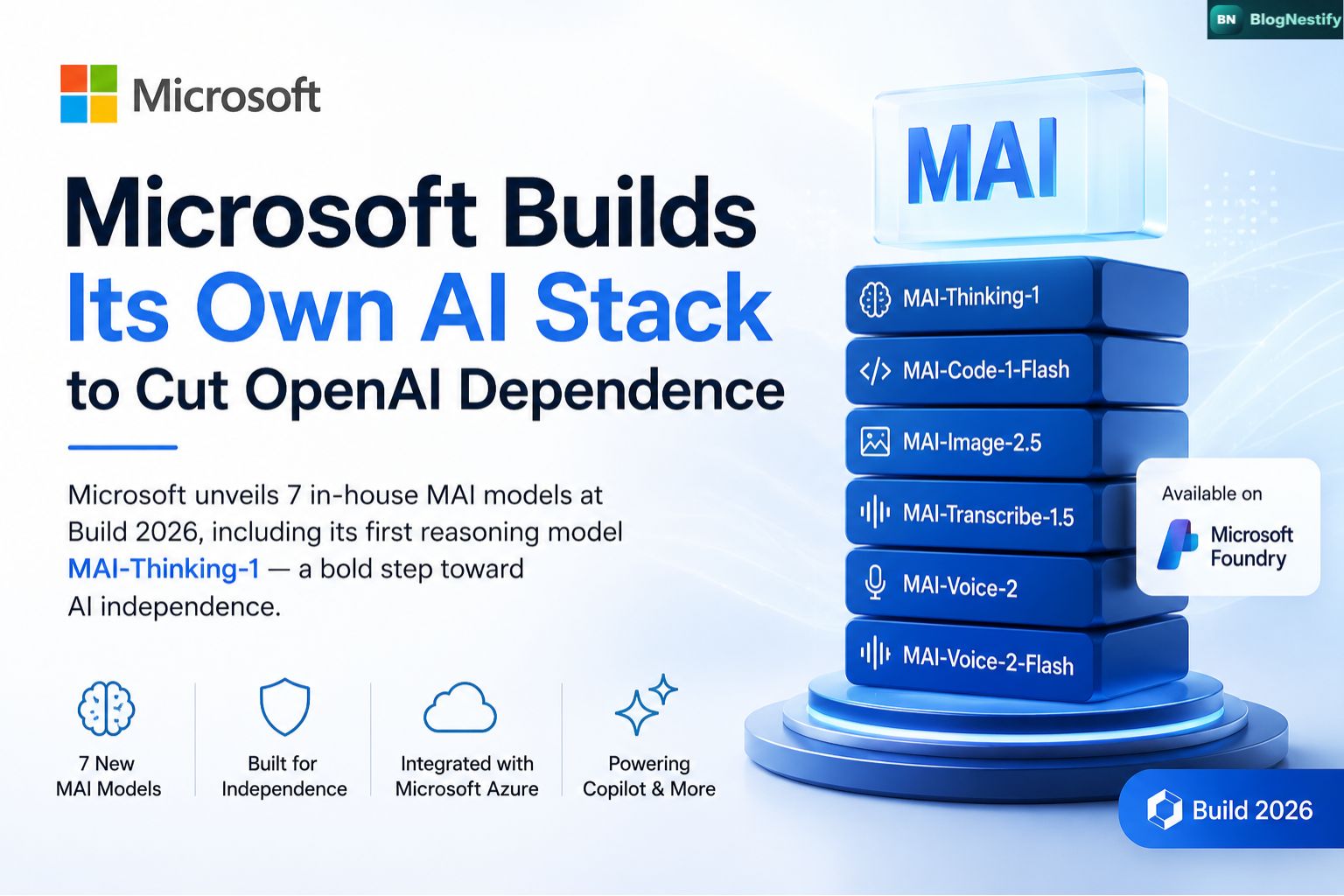
For years, Microsoft's AI ambitions were essentially a retelling of OpenAI's story. But at Build 2026, held in San Francisco in early June, Redmond quietly rewrote the plot. With seven brand-new in-house AI models under the MAI brand — and a freshly restructured partnership that strips Azure of its OpenAI exclusivity — Microsoft is no longer just a distributor of frontier AI. It's a builder of it.
⚡ Key Takeaways
- Microsoft unveiled 7 in-house MAI models at Build 2026, covering reasoning, coding, image, voice, and transcription.
- MAI-Thinking-1 is Microsoft's first reasoning model — 35B active parameters, 256K context window, trained without any OpenAI data.
- The Microsoft-OpenAI deal was restructured on April 27, 2026, ending Azure's exclusive distribution rights over OpenAI models.
- OpenAI models immediately went live on AWS Bedrock the very next day, confirming the deal had been long in preparation.
- Microsoft CEO Satya Nadella framed the moment as a shift from "consuming a frontier model to fully participating at the frontier."
- MAI-Thinking-1 reportedly matches Claude Opus 4.6 on the SWE Bench Pro benchmark — a bold opening statement for a brand-new in-house model.
The Big Picture: Why This Moment Matters
Microsoft has invested over $13 billion in OpenAI and built its entire Copilot product line around GPT models. For a long time, that arrangement was both a competitive advantage and a structural vulnerability — a single supplier relationship for the most strategically important technology in modern enterprise computing.
Then OpenAI began evolving in ways Microsoft didn't control. It filed for its own IPO, began building cloud inference infrastructure, and in February 2026, signed a $50 billion partnership with Amazon Web Services. That deal was structurally incompatible with Microsoft's original exclusivity rights, and after two months of tense negotiations involving lawyers from all three companies, the April 27 restructure arrived as the resolution.
By the time Build 2026 opened its doors, Microsoft had done something far more significant than renegotiating contract terms — it had built a parallel AI stack from scratch.
"We believe the time has come for every company to move from consuming a frontier model to fully participating at the frontier." — Satya Nadella, CEO, Microsoft — Build 2026 Keynote
The April 27 Restructure: What Actually Changed
The original Microsoft-OpenAI agreement gave Azure exclusive cloud distribution rights for OpenAI's models. Enterprise customers who wanted GPT-4, GPT-5, or any OpenAI frontier model had to route those workloads through Microsoft's infrastructure. That exclusivity was the strategic moat — and it's now gone.
| Provision | Before April 27, 2026 | After April 27, 2026 |
|---|---|---|
| Azure Exclusivity | Exclusive distribution | Non-exclusive; any cloud |
| AGI Clause | Existed — deal could terminate if OpenAI declared AGI | Removed entirely |
| Revenue Share | OpenAI paid Microsoft 20% uncapped | Capped at total $38B — saving OpenAI ~$97B |
| Microsoft's Revenue Share Back | Microsoft paid share back to OpenAI | Microsoft stopped paying entirely |
| Azure-First Window | Azure-exclusive launch | 4-month head start on new models, then multi-cloud |
| Microsoft's Equity Stake | ~49% effective | Locked in at 27%, valued at $135B |
Within 24 hours of the April 27 announcement, OpenAI models — including GPT-5.5, GPT-5.4, and the Codex coding agent — went live on AWS Bedrock. The speed of that launch confirmed what industry insiders had suspected: the AWS deal had been ready and waiting, held back only by the exclusivity clause that had just been removed.
Meet the MAI Family: Microsoft's 7 In-House AI Models
Microsoft AI CEO Mustafa Suleiman unveiled the full MAI model lineup at Build 2026, covering nearly every modality that matters in enterprise AI: reasoning, coding, image generation, speech transcription, and voice agents. All models are being rolled out through Microsoft Foundry — the company's unified platform for embedding AI into applications.
Microsoft's first in-house reasoning model. 35B active parameters, 1 trillion total, 256K context window. Trained from scratch, no OpenAI distillation. Private preview on Foundry.
137B total parameters, 5B active. Purpose-built for GitHub Copilot and VS Code. Rolling out to all GitHub Copilot individual plans. Optimized for high performance at low cost.
Microsoft's first text-to-image and image-to-image model. Ranked #2 on the Arena AI leaderboard for image editing. Live in PowerPoint, rolling out to OneDrive. Flash variant for production at scale.
State-of-the-art transcription accuracy across 43 languages. Batch transcription speed 2.5x faster than Azure's existing models. Positioned as the best price-performance of any large cloud provider.
Core voice model for conversational AI agents in 2026's fast-growing voice agent market. Includes audio watermarking and protections against unauthorized voice cloning.
Designed specifically for latency-sensitive real-time voice agent scenarios. Delivers best value and speed for applications where every millisecond of response time matters.
Now live in GitHub Copilot and VS Code for inference-optimized coding tasks. Complementary to MAI-Code-1-Flash, targeting different complexity tiers within the developer toolchain.
MAI-Thinking-1: A Deeper Look at Microsoft's Flagship Reasoning Model
Of all seven models, MAI-Thinking-1 carries the most strategic weight. It's Microsoft's first fully in-house reasoning system — not fine-tuned on top of GPT, not derived through distillation from any third-party model. It is, by Microsoft's account, built entirely from the ground up.
Architecture and Technical Specifications
MAI-Thinking-1 uses a sparse Mixture-of-Experts architecture — a design choice that allows only a subset of the model's parameters to activate for any given request, significantly reducing inference cost without sacrificing output quality. With approximately 35 billion active parameters out of roughly 1 trillion total, it competes in the mid-size weight class while delivering performance that punches considerably above it.
The 256,000-token context window makes it particularly well-suited for enterprise tasks that require processing long documents, extended codebases, or multi-step reasoning chains — exactly the kind of complex, multi-step instructions Microsoft says the model was designed for.
Training Data and Enterprise Provenance
Perhaps the most commercially significant detail about MAI-Thinking-1 is what it was trained on — and what it wasn't. Microsoft explicitly notes that the model was trained entirely on commercially licensed enterprise-grade data with zero distillation from OpenAI's models or any other third-party system. For regulated industries — financial services, healthcare, legal — data provenance is a genuine compliance concern, and this claim directly addresses it.
Benchmark Performance
| Benchmark | MAI-Thinking-1 | Comparison |
|---|---|---|
| SWE Bench Pro (Coding) | Matches Claude Opus 4.6 | On par with Anthropic's flagship |
| Human Blind Evaluations (Surge) | Preferred over Claude Sonnet 4.6 | Wins on overall quality |
| AIME 2025 (Math Reasoning) | 97.0% | Elite-level performance |
| AIME 2026 (Math Reasoning) | 94.5% | Sustained reasoning strength |
| McKinsey Enterprise Tuning | Outperformed GPT-5.5 | 10x better cost efficiency claimed |
Note: All figures are vendor-reported by Microsoft. Independent third-party replication of these benchmarks has not yet been published as of this writing.
How We Got Here: A Timeline of Microsoft's AI Independence Move
What This Means for Enterprise AI Buyers
For IT leaders and enterprise procurement teams, the April-June 2026 sequence represents a genuine structural shift in enterprise AI. The cloud exclusivity that once forced OpenAI workloads onto Azure is gone. Enterprises that previously had no choice but to use Azure for GPT access now have real optionality.
AWS Bedrock now carries OpenAI's full model suite, alongside Anthropic's Claude family, Amazon's own Titan and Nova models, and others. Google Cloud is in similar conversations. The AI model market, which once looked like it might consolidate around a single cloud-model pairing, is now genuinely multi-cloud and multi-model.
For Microsoft, the competitive calculus is different but not necessarily worse. By building its own models, it reduces the margin it pays on inference costs, gains complete control over model roadmaps for its 1P products like Copilot, Word, and PowerPoint, and positions itself as a full-stack AI platform rather than a reseller.
Beyond Models: Microsoft Scout and the Full Agentic Stack
The MAI model announcements don't exist in isolation. Microsoft simultaneously launched Microsoft Scout, its first always-on autonomous agent, built on an architecture called OpenClaw and integrated directly into Microsoft Teams. Scout can proactively schedule meetings, prepare briefing materials, and take action across Microsoft 365 — without being explicitly prompted each time.
The vision Nadella articulated at Build is one where Windows and Microsoft 365 serve as the control layer for an agentic computing era — where agents, not apps, are the primary way people interact with software. The MAI models are the engine. Microsoft Foundry is the platform. And Copilot, built on top, is the product layer that enterprise users will actually touch.
Microsoft also announced hardware partnerships with Nvidia for AI-optimized laptops and PCs, and unveiled a quantum chip of its own — extending its ambitions well beyond software into the full AI infrastructure stack.
Safety and Responsible AI Built In
Microsoft was deliberate in addressing the safety characteristics of the MAI family. Voice models include built-in protections against unauthorized voice cloning, and all model outputs are watermarked. The company says it has worked to reduce over-refusals — a long-standing frustration among enterprise users — and has improved representation in outputs, including for people with disabilities. A detailed safety card is being published alongside the models.
Frequently Asked Questions
The Bottom Line
The narrative that Microsoft is "breaking up" with OpenAI is both true and incomplete. The partnership survives — Microsoft still holds a significant stake, and GPT-5 remains the backbone of Copilot for general reasoning. What has changed is the dependency structure. Microsoft is no longer betting its AI future on a single external model provider. The MAI models, Microsoft Foundry, Microsoft Scout, and the agentic hardware push collectively represent a company that is, for the first time, building at the frontier rather than reselling it.
The message Satya Nadella delivered at Build 2026 was directed simultaneously at OpenAI, at AWS, and at the enterprise market: Microsoft's AI story no longer depends on any single model provider — including the one it helped create.
Whether MAI-Thinking-1 will ultimately displace GPT in Copilot's core reasoning layer, and whether Microsoft's in-house model quality can keep pace with the frontrunners at OpenAI and Anthropic, are questions that will be answered over the next 12–18 months. But the structural pivot is real, and it's already underway.
Stay Ahead of AI's Biggest Moves
Get in-depth analysis of AI, tech, and business developments — straight from Blognestify, no fluff.
Explore More on Blognestify →
0 Comments
Leave a Comment