Apple Unveils Siri AI at WWDC 2026: Smarter Voice Assistant, New App & Tim Cook's Final Developers Conference
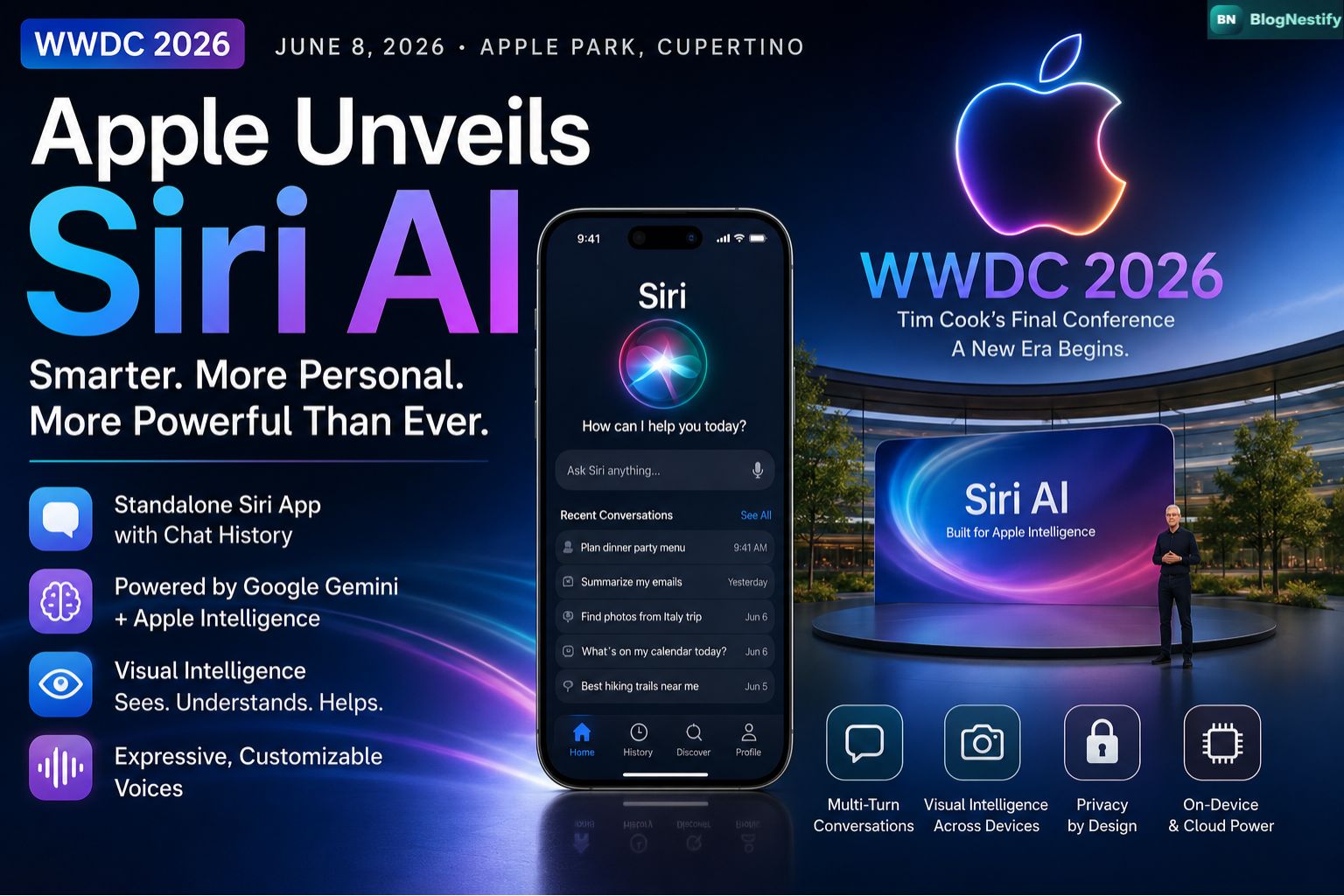
At a landmark WWDC 2026 keynote on June 8, Apple unveiled a completely rebuilt Siri powered by Google Gemini — complete with a standalone app, multi-turn conversations, and customizable voices. It was also Tim Cook's last conference before handing over to John Ternus as CEO this September.
WWDC 2026 · June 8, Cupertino
Apple Park, Cupertino, California — Apple's annual Worldwide Developers Conference 2026 keynote
⚡ Quick Summary — What You Need to Know
- Apple officially unveiled Siri AI at WWDC 2026, the biggest Siri overhaul since 2011.
- Siri now has its own dedicated standalone app with chat history synced via iCloud.
- The new assistant is powered by Google Gemini for cloud tasks and Apple's own on-device models.
- Expressive, customizable voices with adjustable pace and tone are now available.
- Visual Intelligence lets Siri see and understand your camera, screen, and photos.
- WWDC 2026 was Tim Cook's final conference before John Ternus takes over as CEO in September.
- Siri AI launches in English markets only — not available in EU or China at launch.
WWDC 2026: Apple's Biggest AI Moment in Years
Monday, June 8, 2026 will be remembered as a defining moment in Apple's history — and not just because the company finally delivered on its long-awaited Siri overhaul. The annual Worldwide Developers Conference at Apple Park, Cupertino, also served as the last hurrah for CEO Tim Cook, who will hand the reins to John Ternus this September after 15 transformative years at the helm.
At the centre of it all was Siri AI — a fundamentally rebuilt voice assistant that Apple is pitching as its most significant product update in years. Gone is the Siri that forgot your last question. In its place is a context-aware, conversational assistant that can chain together tasks across apps, understand what's on your screen, and even hold an actual back-and-forth conversation.
What Is Siri AI? Everything Announced
Apple's new Siri AI is built on the Apple Intelligence architecture that the company first introduced in 2024, but this version is dramatically more capable. It uses a combination of on-device processing and private cloud compute to provide a fast, privacy-preserving AI experience.
1. A Standalone Siri App — Finally
For the first time ever, Siri gets its own dedicated app. Designed like a modern AI chatbot interface, the Siri app stores your full conversation history and syncs privately across all your Apple devices through iCloud. It's visually similar to ChatGPT's interface — with a card-based layout for previous queries — and lets you pick up a conversation right where you left off, whether on your iPhone, Mac, or iPad.
2. Multi-Turn Conversations and Deep Context
The old Siri lived in the moment. Each interaction was isolated. Siri AI is fundamentally different: it remembers the thread of a conversation, follows up on previous questions, reads across your apps (Messages, Mail, Calendar, Photos), and builds a holistic picture of what you need.
In one demo at WWDC, a presenter asked Siri about a dessert he'd heard about at an event. Without any extra prompting, Siri found the reference buried in his Messages history, assembled a dinner party menu around it, drafted a message to his contacts with the menu attached, and offered send and edit buttons — all in one seamless thread.
3. Visual Intelligence Across Every Platform
Visual Intelligence is arguably the most exciting addition. On iPhone, a new dedicated Siri mode sits directly inside the Camera app — alongside Photo, Video, Portrait, and Panorama. Point your iPhone at anything — a product, a landmark, a piece of text — and Siri will understand it and answer questions about it in real time. The feature leverages Google Image Search for object and scene identification.
Visual Intelligence: Where It Works
- iPhone: Dedicated Siri Camera mode for real-time scene understanding
- Mac: Keyboard shortcuts to query any on-screen content via Visual Intelligence
- iPad: Integrated into the screenshot experience for instant context
- Apple Vision Pro: Ask about physical objects around you simply by looking at them
4. Expressive, Customizable Voices
Siri's voice has always felt robotic and limited. With Siri AI, Apple introduces a completely new voice engine with micro-adjustable settings for expressivity and speaking pace. During initial setup, users tune exactly how animated or measured they want Siri to sound. Previously, Siri offered only two accented voice options; now the customization goes meaningfully deeper, making every user's Siri experience feel genuinely their own.
5. Dynamic Island and New Activation Methods
Siri AI finds a new home in the Dynamic Island on iPhone, offering a quick visual and interactive way to engage with the assistant without leaving the current app. A new swipe-down gesture reveals a "Search or Ask" interface that supports both voice and text input for continuous conversation. On Mac, Siri is built directly into Spotlight. Apple Watch, Apple Vision Pro, and macOS all get their own Siri AI integration paths.
6. Agentic Capabilities: Siri That Acts For You
Siri AI now extends into what Apple calls agentic workflows. The updated Passwords app, for example, can automatically navigate to websites, sign you in, and update credentials in the background when you need to change a password — no manual site-hopping required. Apple is also integrating agent-style capabilities with the App Store, allowing users to delegate tasks like booking reservations, managing files, and controlling smart home devices.
Google Gemini Powers the Cloud Side of Siri AI
Perhaps the most surprising WWDC announcement was Apple's deep collaboration with Google. The new Apple Foundation Model (AFM) Cloud Pro — handling the most demanding AI tasks — runs on Nvidia GPUs within Google's cloud infrastructure and is comparable in capability to Google's own Gemini Frontier models.
Apple was careful to frame this around privacy: Craig Federighi, SVP of Software Engineering, stated that "data is only used to execute your request" and that outside experts can independently verify this promise at any time. On-device processing handles personal and sensitive queries, while only harder tasks are routed to the cloud.
⚠️ Availability Note
Siri AI will not be available in the European Union or China at launch due to the Digital Markets Act (DMA). English-speaking markets get access first, with broader rollout planned for 2027.
Device Requirements for Siri AI
Not all Apple devices will support every Siri AI feature. The most powerful on-device capabilities require significant hardware. Here's the full breakdown:
| Device | Siri AI Support | Requirement |
|---|---|---|
| iPhone 17 Pro / Pro Max | Full Siri AI + Expressive Voices | iOS 27, 12GB unified memory |
| iPhone Air | Full Siri AI + Expressive Voices | iOS 27, 12GB unified memory |
| iPad (M4 or later) | Full Siri AI | iPadOS 27, 12GB unified memory |
| Mac (M3 or later) | Full Siri AI via Spotlight | macOS Golden Gate, 12GB unified memory |
| Apple Vision Pro (M5) | Full Siri AI + Expressive Voices | visionOS 27 |
| Apple Watch | Companion Siri AI experience | watchOS 27 |
iOS 27, macOS Golden Gate and the Full OS Lineup
Beyond Siri AI, Apple announced a complete refresh of its operating systems. In line with last year's naming convention, the new software is called iOS 27, iPadOS 27, macOS 27 (Golden Gate), tvOS 27, watchOS 27, and visionOS 27. Key highlights across the OS updates include:
WWDC 2026 OS Highlights
- Safari: AI-powered tab management with intelligent grouping
- Passwords: Agentic one-tap credential updating across sites
- Parental Controls: Granular "Ask to Browse" and "Ask to Buy" defaults for children under 13
- Photos: Enhanced Apple Intelligence for scene recommendations
- Cross-App Context: Siri now reads across Messages, Mail, Calendar, and Notes
- Dictation: System-wide accuracy improvements for all apps
A public beta for iOS 27 and the rest of the OS suite begins in July 2026, with the full consumer release expected in autumn 2026 alongside new iPhone hardware.
Tim Cook's Final WWDC: A Moment of History
This year's conference carried genuine emotional weight. Tim Cook, who has led Apple since 2011, opened and closed the WWDC keynote in what were among his final public appearances as CEO. He received an extended standing ovation from developers and told the audience he is "deeply grateful to have been on this journey" with them.
Cook announced his retirement from the CEO role in April 2026, ending a remarkable 15-year run. Under his leadership, Apple's market capitalization soared by more than $4 trillion, and the company expanded dramatically beyond hardware into services like Apple Pay, Apple Music, and Apple News+. His share price legacy? Roughly a 2,000% increase on a split-adjusted basis.
Despite this, Apple's AI track record has been a notable blemish — what one industry analyst bluntly called "one of the big black eyes" of Cook's tenure. WWDC 2026 was his last opportunity to show a meaningful turning point before passing the torch.
Who Is John Ternus, Apple's Next CEO?
John Ternus, 50, will become Apple's next CEO on September 1, 2026. A mechanical engineer by training — he holds a degree from the University of Pennsylvania — Ternus has spent over 25 years at Apple, including the past decade as Senior Vice President of Hardware Engineering overseeing the development of the iPhone, iPad, Mac, and Apple Silicon chips.
Cook will remain at the company as executive chairman, continuing to advise on select areas. Separately, Johny Srouji has been named chief hardware officer, maintaining deep hardware expertise at the top of the company. The challenge now falls to Ternus to connect Apple's AI strategy across software, hardware, and the developer ecosystem in a way that makes Siri AI feel indispensable to everyday iPhone users.
Apple vs. Google vs. OpenAI: The AI Race
Make no mistake — WWDC 2026 is Apple playing catch-up. ChatGPT, Google Gemini, and Samsung's Galaxy AI have all moved faster. But Apple's argument has always been different: privacy-first AI, deeply integrated into hardware. The company is betting that users will ultimately value an assistant that knows everything about them without that data leaving their device.
Craig Federighi made this explicit: while competitors appear to be racing to develop "AI for the sake of AI," Apple is focused on AI that solves real daily problems. Whether Siri AI's privacy-centred design can win back the confidence of users frustrated by years of delays remains the defining question for the Ternus era.
When Does Siri AI Launch?
🔑 Key Takeaways from Apple WWDC 2026
- Siri AI is the most significant Siri upgrade since the assistant launched in 2011 — built from the ground up with multi-turn conversation and cross-app context.
- A standalone Siri app with chat history synced via iCloud brings Apple squarely into competition with ChatGPT and Gemini.
- Google Gemini powers Siri AI's cloud model (AFM Cloud Pro), while on-device processing keeps private queries local.
- Visual Intelligence transforms the camera into an AI interface across iPhone, iPad, Mac, and Vision Pro.
- Siri AI launches in English-speaking markets only — EU and China users must wait due to regulatory constraints.
- Full Siri AI requires iPhone Air, iPhone 17 Pro/Max, M4 iPad, M3 Mac, or M5 Vision Pro with 12GB unified memory.
- WWDC 2026 marks the end of the Tim Cook era — Apple's next chapter belongs to John Ternus, who takes over as CEO in September 2026.
0 Comments
Leave a Comment